
The PMP Exam Is Changing in July 2026: What Every Candidate Needs to Know
The Project Management Professional (PMP) certification remains the most recognized project management credential in the world. Every few years, the Project Management Institute (PMI) updates the exam to reflect how the profession evolves. The next major update arrives in July 2026, and it brings meaningful changes to the exam structure, question types, eligibility requirements, and the skills PMI expects certified professionals to demonstrate.
This article provides a complete, practical overview of what is coming, why these changes matter, and how PMP candidates should prepare.
Why PMI Updated the Exam
PMI’s changes follow the 2025 Job Task Analysis (JTA) study, which collects feedback from thousands of project practitioners, PMO leaders, recruiters, and industry experts. The findings showed three clear trends:
- The project manager’s role is becoming more strategic.
PMs are no longer only executing tasks. They contribute to business decisions, shape organizational alignment, and influence strategic outcomes. - Sustainability and artificial intelligence are now core expectations.
Organizations need PMs who understand sustainability obligations and can work within AI-supported environments. - Delivery is now predominantly hybrid.
Most real projects blend predictive and agile approaches, and the exam will reflect this reality.
PMI calls this part of its “Close the Gap” strategic shift, which aims to align PM capabilities with organizational expectations worldwide.
For more information about the new PMP Exam Content Outline, please read more on PMI’s page on the new exam.
1. New Domain Weights (Effective July 2026)
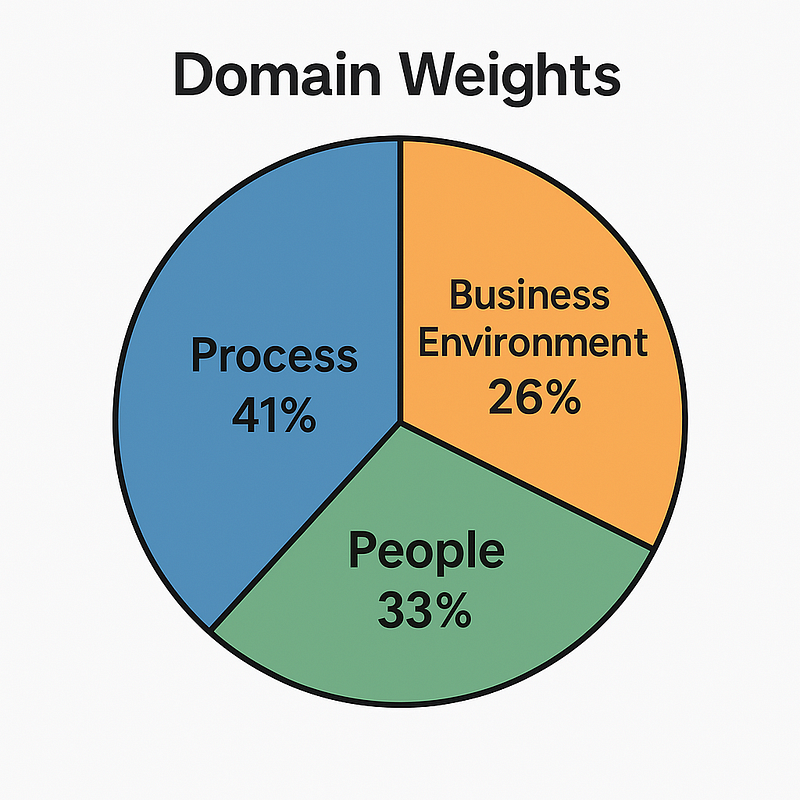
The PMP exam continues to assess the same three domains, but the emphasis shifts significantly. The most notable change is the rise of the Business Environment domain.
PMP Exam Domain Weights
What this means for candidates
- Business strategy, organizational alignment, compliance, and enterprise-level factors will feature more prominently.
- People-related and process-related questions remain important but represent a smaller portion of the exam.
- PMs must show stronger business acumen, not only technical execution abilities.
This is not a new body of knowledge, but a reshuffle of where certain topics now belong.
2. Shift in Delivery Approaches
The exam’s updated delivery-approach distribution reflects the reality of modern projects.
New Split
- Predictive (Waterfall): ~40 percent
- Agile + Hybrid: ~60 percent
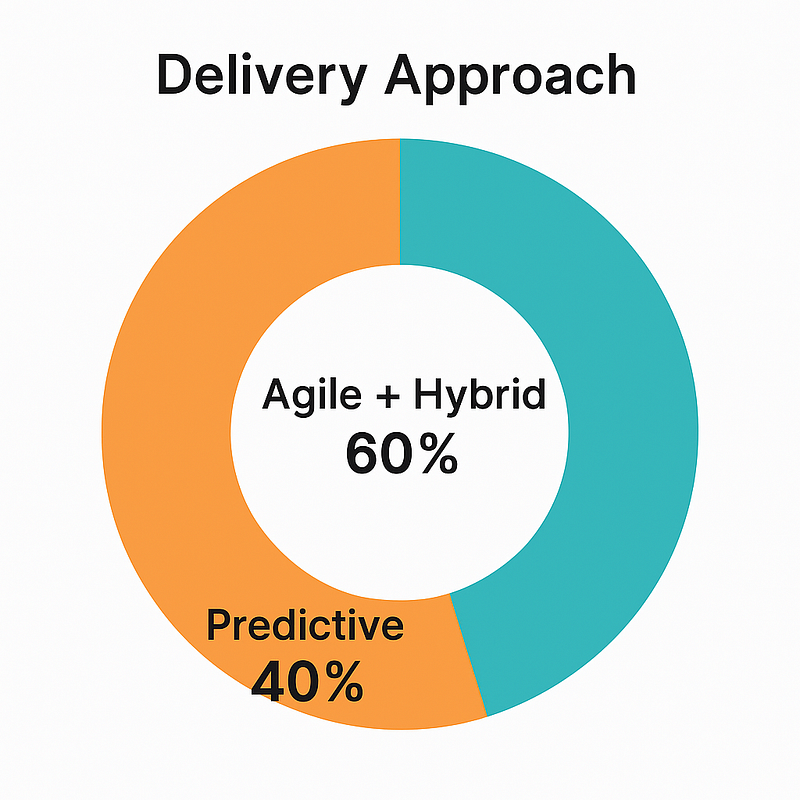
The exam will still include predictive lifecycle questions, but agile and hybrid influence a greater share.
Impact on study strategy
- Candidates need balanced proficiency across Scrum, XP, Kanban, hybrid governance, scaled agile coordination, and predictive planning.
- PMI is reinforcing that agile is now the industry default in many sectors.
3. Key Content Additions
Two themes guide the new exam content:
A. Sustainability Integrated Across Domains
PMI now expects project managers to demonstrate:
- awareness of sustainability requirements tied to project outcomes
- understanding of environmental, social, and governance (ESG) obligations
- ability to incorporate sustainability principles into quality planning
- use of risk responses that address sustainability risks
- compliance alignment related to sustainability mandates
This aligns the PMP exam with global regulatory expectations and modern corporate responsibility standards.
B. Artificial Intelligence as an Exam Thread
Rather than treating AI as a standalone topic, PMI integrates AI throughout existing processes. Candidates will encounter:
- examples of AI-supported scheduling
- automated data analysis
- machine-assisted forecasting
- ethical considerations in AI-enabled environments
AI becomes part of how PMs plan, execute, and monitor projects.
C. Expanded Financial Management Skills
The updated exam includes deeper financial expectations, such as:
- assessing financial needs
- quantifying risk and contingency allocation
- forecasting spending
- reporting financial outcomes
- managing financial reserves
This change reinforces the PM’s responsibility for cost stewardship and decision support.
4. New Exam Format and Timing
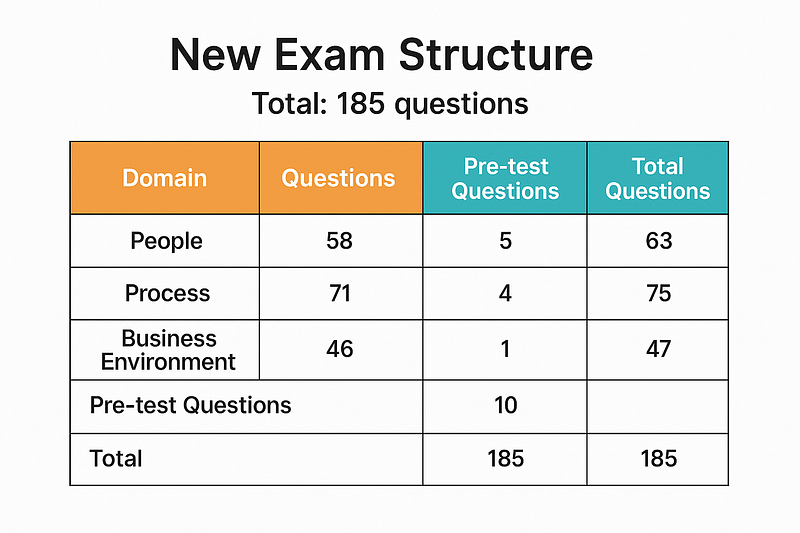
The physical exam experience also receives an update.
What these changes mean
- You receive more total time (4 hours) and slightly more questions (185 questions instead of 180)
- More pretest questions help PMI validate new question types.
- Shorter breaks mean candidates need to manage exam stamina more intentionally (2 x 5 minute breaks instead of 2 x 10 minutes breaks previously)
5. New Question Types
The 2026 exam introduces new interactive and scenario-rich formats designed to reflect real project situations.
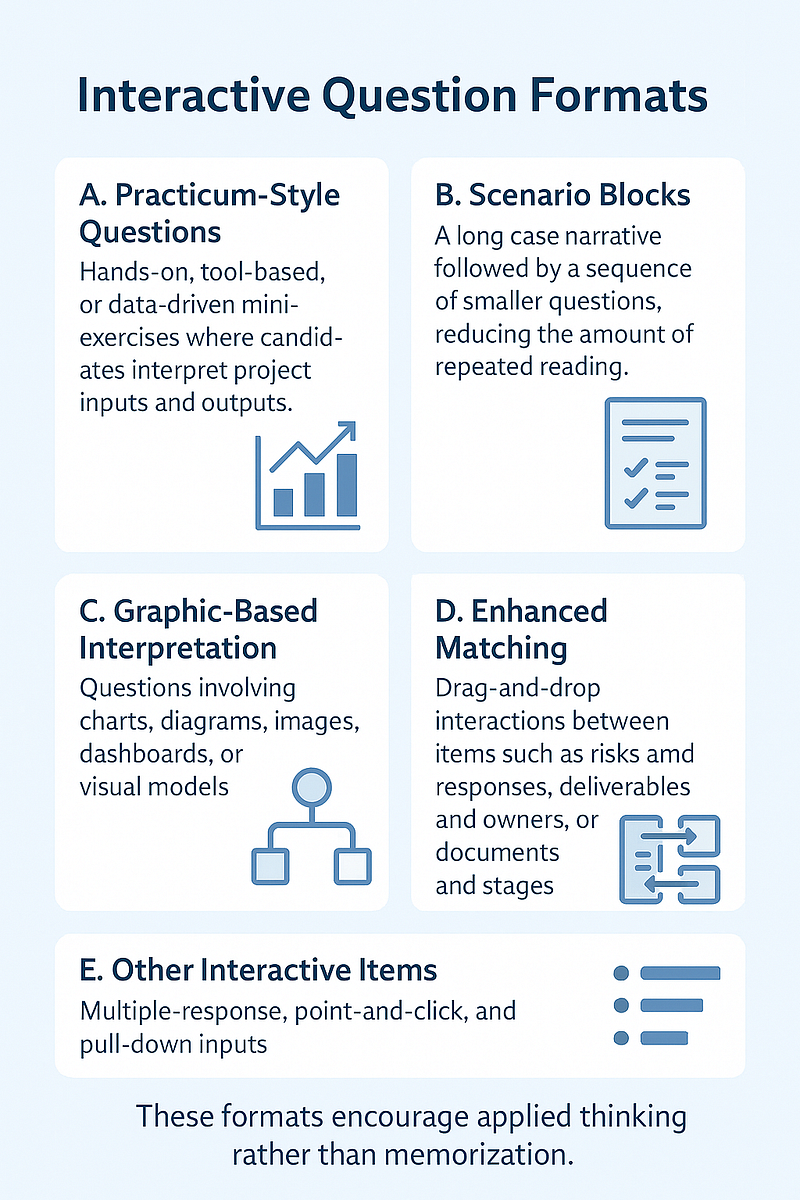
A. Practicum-Style Questions
Hands-on, tool-based, or data-driven mini-exercises where candidates interpret project inputs and outputs.
B. Scenario Blocks
A long case narrative followed by a sequence of smaller questions, reducing the amount of repeated reading.
C. Graphic-Based Interpretation
Questions involving charts, diagrams, images, dashboards, or visual models.
D. Enhanced Matching
Drag-and-drop interactions between items such as risks and responses, deliverables and owners, or documents and stages.
E. Other Interactive Items
Multiple-response, point-and-click, and pull-down inputs.
These formats encourage applied thinking rather than memorization.
6. Updated Eligibility Requirements
PMI makes several important adjustments that take effect with the 2026 exam rollout.

A. Experience Lookback Extended to 10 Years
All project management experience must fall within a 10-year window, increased from the previous eight-year period.
B. New Educational Equivalence Model
PMI now uses global qualification frameworks to determine whether a candidate’s education meets eligibility requirements.
C. Updated Training Hour Requirements
The requirement remains 35 hours of training.
Active CAPM holders earn 23 hours of credit, needing only 12 hours of additional training.
These changes streamline eligibility while aligning PMI with global standards.
7. Pilot Exam Opportunity (December 2025 — January 2026)
Before the official launch in July 2026, PMI will run a limited pilot exam.
Key Dates
- Registration opens: 15 December 2025
- Pilot exam window: 5–30 January 2026
- Test centers: In-person, English only
Benefits of joining the pilot
- 20 percent fee rebate
- Early certification using the updated exam
- Free retake if you do not pass
- Influence final question calibration through feedback
Considerations
- Scores may take longer to report because PMI needs time to validate question performance.
- Only a limited number of seats will be available.
8. Should You Take the Exam Before or After the Change?
Take the exam before July 2026 if:
- You already have strong preparation
- You prefer the current question types
- You want predictable exam structure
- You want to avoid learning new sustainability or AI content
Wait for the 2026 exam if:
• You start studying in mid-2026 or later
• You prefer visual and interactive question styles
• You are comfortable with sustainability, AI, and hybrid delivery
• You want to benefit from the pilot discount and free retake option
Both versions of the PMP remain equally valid worldwide.
9. Recommended Study Strategy
From Project Victor’s perspective, PMP candidates should consider the following adjustments:
- Strengthen understanding of business alignment, compliance, and strategic decision support.
- Incorporate sustainability and AI-related applications into practice exams.
- Practice hybrid delivery scenarios, especially scaling and governance.
- Use mock exams that include interactive questions.
- Increase focus on financial planning and risk-based contingency management.
Final Thoughts
The July 2026 update modernizes the PMP exam and aligns it with what organizations expect from today’s project managers. The exam is more strategic, more analytical, and more reflective of real practice. Whether you are planning to sit for the exam before or after the change, early awareness of these updates gives you a clear advantage.
Project Victor will continue to guide PMP candidates through both versions of the exam with updated materials, workshops, mock exams, and advisory support.
🎓 How Project Victor Helps You Get PMP® Certified
Project Victor is Thailand’s #1 PMP® Training Provider and a PMI Authorized Training Partner (ATP). We help professionals in Thailand pass the PMP® exam with confidence through:
✅ 35-hour PMP® Exam Prep Bootcamps
(Live in-class or online | Available in Thai and English)
✅ One-on-one support for application review & PMI eligibility
✅ PMP® Exam Simulator with over 3,000+ practice questions
✅ Private coaching sessions with PMI-authorized instructors
📞 Ready to start your PMP® journey?
🌐 Website: www.projectvictor.com
📱 LINE Official: @projectvictor
📞 Tel: +66 92 348 4772
Disclaimer
“PMBOK”, “PMP”, and “PMI” are registered trademarks of the Project Management Institute, Inc. This article is independently written for educational purposes and is not affiliated with or endorsed by PMI.